Health Desk ( Tv10 Punjab )
Sandeep Dhand
Nutritionist And Health Educator
We live in an era where we have more medical technology than ever before, yet we are seeing a terrifying trend: healthy-looking people, often in the prime of their lives, are suddenly collapsing. It happens at the gym, in the office, or at home. One minute they are fine, and the next, their heart simply stops. This is Sudden Cardiac Arrest (SCA).
For a long time, we associated heart issues with old age. But the “old man’s disease” has become a modern-day epidemic affecting everyone from teenagers to athletes. While genetics and stress play a role, the biggest culprit hiding in plain sight is the food on our plates.
The Silent Switch: What Exactly is Cardiac Arrest?
Before we blame the burger, we need to understand the mechanism. Most people use the terms “Heart Attack” and “Cardiac Arrest” interchangeably, but they are fundamentally different.
A Heart Attack is a “Plumbing” Problem: A blockage forms in an artery, and a part of the heart muscle begins to die because it isn’t getting oxygen. The person is usually conscious and feels intense chest pain.
Cardiac Arrest is an “Electrical” Problem: The heart’s internal rhythm goes haywire. It stops beating effectively and starts “quivering” (fibrillation). Within seconds, blood stops flowing to the brain. The person collapses instantly, stops breathing, and has no pulse.
In many cases, a heart attack leads to a cardiac arrest, but the food we eat can trigger both.
The “Slow Poison” on Our Plates
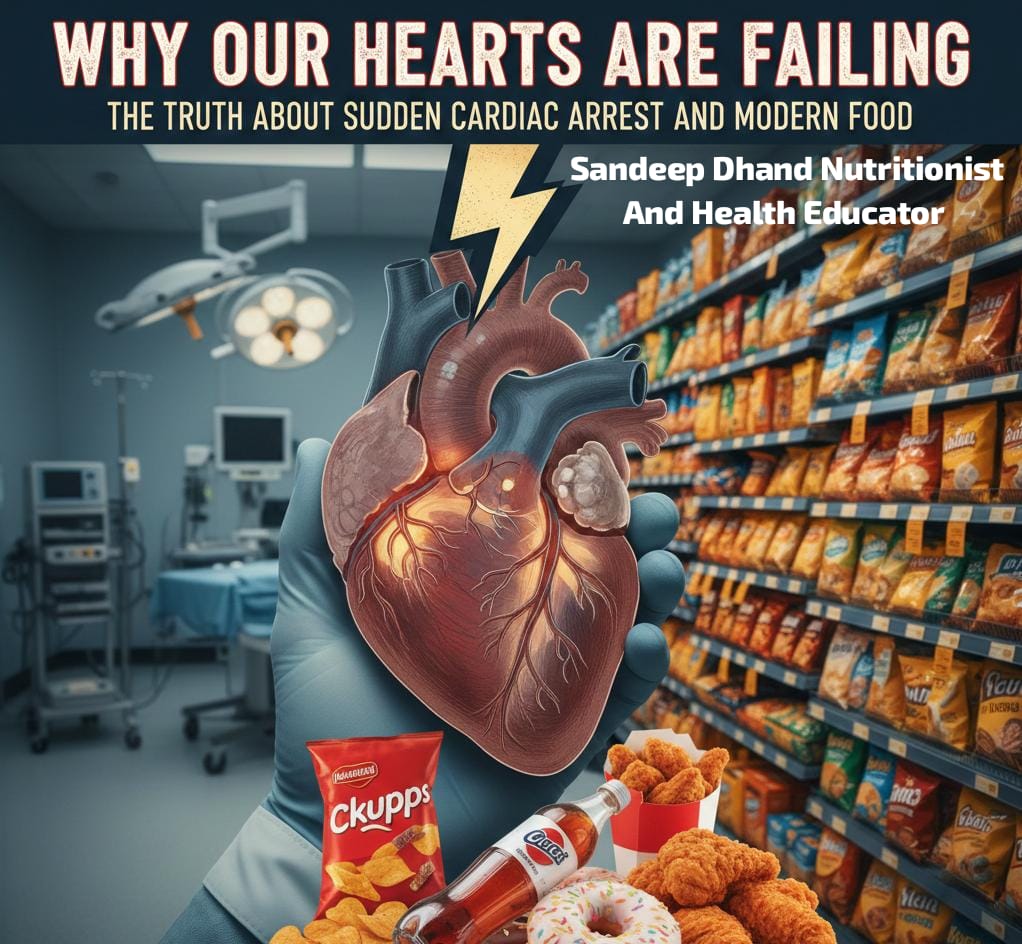
If you look at the ingredients of a standard modern diet—fast food, packaged snacks, and sugary drinks—you aren’t just looking at calories; you are looking at a chemical blueprint for heart failure.
- The Trans-Fat Trap
Trans-fats are the ultimate villain. They are found in commercially fried foods, bakery items, and many margarines. They do two things: they skyrocket your “bad” cholesterol (LDL) and vanish your “good” cholesterol (HDL). Over time, this creates a thick, waxy buildup in your arteries called plaque. When a piece of this plaque breaks off, it can cause an instant electrical short-circuit in the heart. - The Sugar Spike and Inflammation
We often think sugar only causes diabetes. However, high sugar intake causes chronic inflammation in the blood vessels. Think of it like “internal rusting.” When your vessels are inflamed, your heart has to pump harder, and the electrical signals that keep your heart rhythm steady become unstable. - The Salt Secret
Salt (sodium) is essential, but we eat it in massive quantities through processed foods. Excess salt holds water in your body, increasing the volume of your blood. This puts immense pressure on your heart walls. Over time, the heart becomes “thick” (hypertrophy), and a thick heart is much more likely to experience a fatal rhythm disturbance.
The Gym Culture and “Fake” Health
A worrying new trend is the rise of cardiac arrest among fitness enthusiasts. Why? Because many are chasing “looks” rather than “health.”
Stimulant Overload: High-caffeine pre-workout drinks and “fat burners” put the heart in a state of constant emergency.
Protein Obsession: Over-consuming low-quality protein supplements without fiber can strain the kidneys and alter electrolyte levels (like potassium and magnesium), which are the “batteries” that keep the heart’s electricity running.
The Warning Signs (They Aren’t Always Obvious)
While SCA is “sudden,” the body often sends “whispers” before the “shout.” If you have been eating poorly, watch out for:
Extreme fatigue that you can’t explain.
A fluttering feeling in the chest (palpitations).
Shortness of breath after climbing just a few stairs.
Frequent lightheadedness or blackouts.
Reversing the Risk: A Return to Real Food
The good news? The heart is incredibly resilient. You can lower your risk significantly by making “human” choices instead of “industrial” ones.
Eat “One-Ingredient” Foods: An apple is an apple. An egg is an egg. A lentil is a lentil. These don’t have hidden chemicals or excessive sodium.
Respect the Electrolytes: Your heart’s electricity depends on Potassium (found in bananas, coconut water, and spinach) and Magnesium (found in seeds and nuts).
The 80/20 Rule: You don’t have to be perfect. If 80% of your food comes from nature, your heart can usually handle the 20% that comes from a packet.
The Bottom Line
Sudden Cardiac Arrest is a terrifying event, but it is rarely a random act of fate. It is often the result of years of “internal friction” caused by what we consume. We are currently living in a world designed to make our hearts fail—through stress, sedentary jobs, and addictive, unhealthy food.
Choosing healthy food like salad instead of a burger, or drinking water instead of soda, is not just about body shape or weight. It is mainly about protecting your heart. Your heart works day and night without stopping. It beats around 100,000 times every day to keep you alive. When you eat unhealthy food, your heart has to work harder. But when you choose healthy food, you help your heart stay strong and healthy. Good food is like fuel for your heart, helping it work better and for a longer time.