Health Desk
Sandeep Dhand Nutritionist And Health Educator
Introduction
Charles Bonnet Syndrome (CBS) is a condition in which a person with poor vision begins to see things that are not actually there. These visual experiences are called visual hallucinations. The important point is that the person usually knows that what they are seeing is not real.
This condition is not a mental illness. It does not mean that the person has lost their mind. It happens mainly because the eyes are not sending clear images to the brain. When the brain does not receive enough visual information, it sometimes creates its own images.
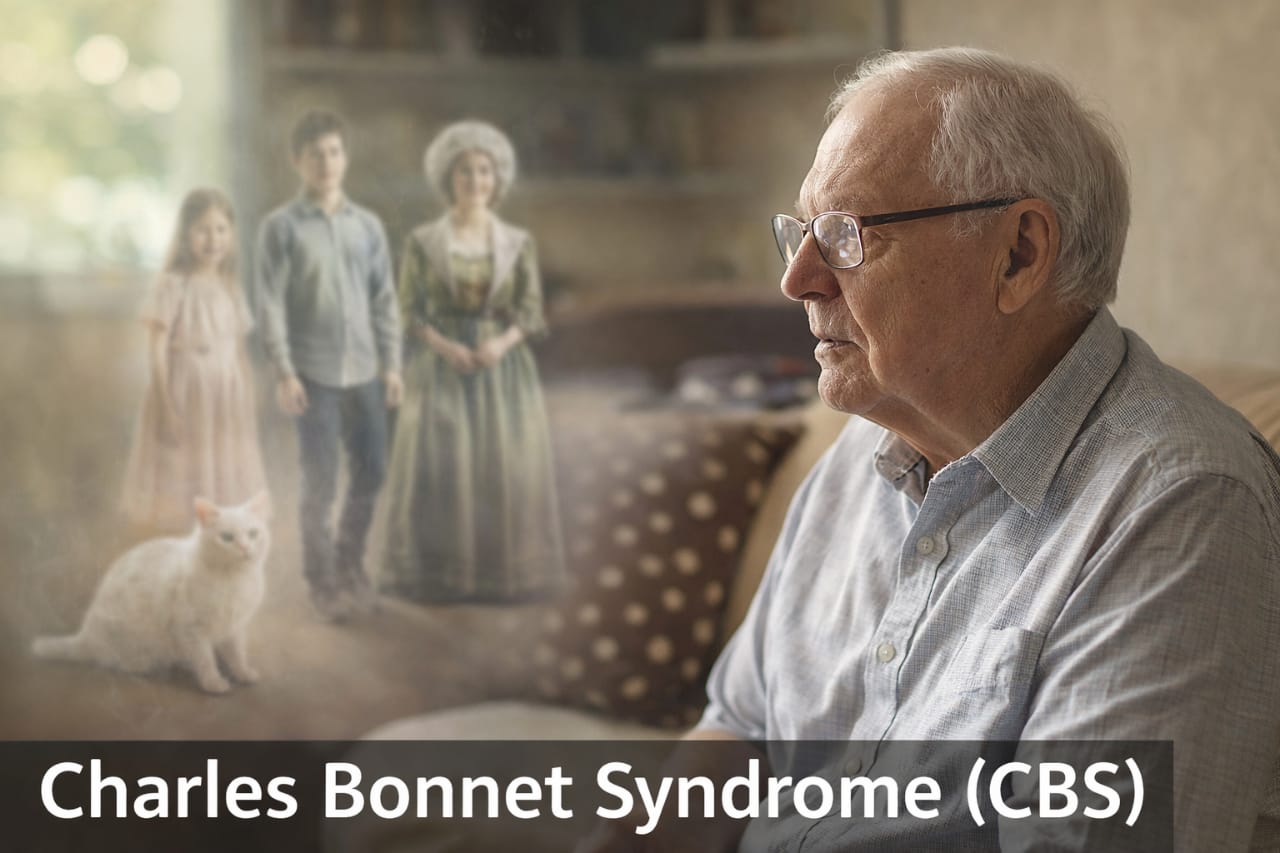
Charles Bonnet Syndrome is more common in older adults, especially those who have serious eye problems. However, it can happen to anyone with significant vision loss.
In this article, we will understand Charles Bonnet Syndrome in simple language — its causes, symptoms, risk factors, diagnosis, treatment, and ways to manage it.
What Is Charles Bonnet Syndrome?
Charles Bonnet Syndrome is a condition where a person with reduced vision sees images that are not real. These images can be simple shapes or very detailed scenes.
The key features of CBS are:
The person has vision loss
The hallucinations are only visual
The person is mentally aware that the images are not real
There are no other psychiatric symptoms
The hallucinations can appear suddenly and may last for seconds, minutes, or even hours. They can happen daily or only once in a while.
History of Charles Bonnet Syndrome
Charles Bonnet Syndrome is named after a Swiss philosopher named Charles Bonnet. In 1760, he described the case of his grandfather, who had poor vision due to cataracts. His grandfather began seeing people, birds, and buildings that were not real. However, he knew these images were imaginary.
Later, doctors realized that many people with vision loss experience similar symptoms. The condition was then named after Charles Bonnet.
How Common Is Charles Bonnet Syndrome?
Many experts believe that Charles Bonnet Syndrome is underreported. Many people do not tell their doctors because they are afraid of being labeled mentally ill.
Studies suggest that:
Around 10–30% of people with severe vision loss may experience CBS.
It is more common in older adults.
It can also happen in younger people with serious eye damage.
Because people feel embarrassed or scared, the real number may be higher.
Why Does Charles Bonnet Syndrome Happen?
To understand CBS, we need to understand how the brain works.
The Brain and Vision
When we look at something:
Light enters the eyes.
The retina sends signals to the brain.
The brain creates the image we see.
If the eyes are damaged, the brain does not receive clear signals. When there is little or no visual input, the brain may start creating its own images. This is similar to:
Phantom limb pain (when a person feels pain in a limb that has been removed)
Dreaming while awake
Doctors believe that when the visual part of the brain becomes “under-stimulated,” it becomes overactive and starts producing images.
This is called the release phenomenon — the brain releases stored images from memory.
Who Is at Risk?
Charles Bonnet Syndrome usually happens in people who have serious eye diseases.
Common Risk Factors
Age-related macular degeneration (AMD)
Glaucoma
Cataracts
Diabetic retinopathy
Retinal detachment
Stroke affecting the visual area of the brain
Severe untreated eye injury
Older adults are more at risk because eye diseases are more common with aging.
Types of Hallucinations in Charles Bonnet Syndrome
The hallucinations in CBS are only visual. There are no sounds, voices, smells, or touch sensations.
These hallucinations can be divided into two types:
- Simple Hallucinations
These include:
Flashes of light
Geometric patterns
Grids or lines
Colored shapes
Repeating patterns
They are usually less disturbing. - Complex Hallucinations
These may include:
People (sometimes strangers)
Animals
Children
Faces
Buildings
Landscapes
Scenes from the past
These images can be very clear and detailed.
How Long Do Hallucinations Last?
Hallucinations may:
Last for a few seconds
Continue for several minutes
Appear multiple times a day
Disappear for months and then return
In many cases, symptoms improve after 12–18 months, but some people may experience them for several years.
Emotional Impact of Charles Bonnet Syndrome
Even though CBS is not a mental illness, it can cause emotional stress.
Many people feel:
Fear
Confusion
Embarrassment
Anxiety
Depression
Some people are afraid to tell their family or doctor. They worry that others will think they are mentally unstable.
Education is very important. Once patients understand that this condition is linked to vision loss and not madness, their fear reduces.
How Is Charles Bonnet Syndrome Diagnosed?
There is no specific test for CBS. Diagnosis is based on:
History of vision loss
Visual hallucinations only
No signs of mental illness
No memory problems like dementia
Doctors may perform:
Eye examination
Brain imaging (if needed)
Memory tests
Neurological examination
The doctor must rule out other causes such as:
Schizophrenia
Delirium
Dementia
Parkinson’s disease
Drug side effects
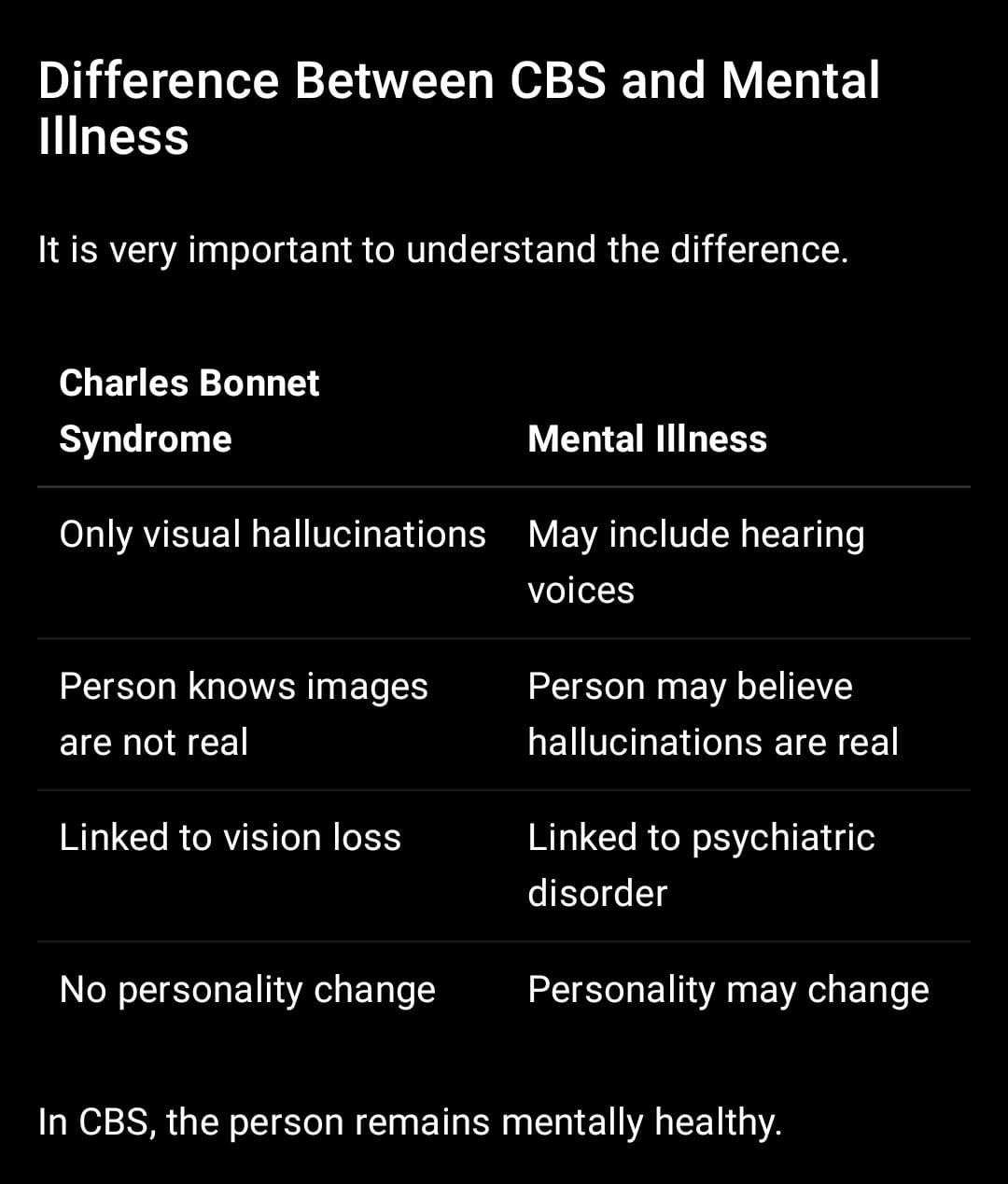
Difference Between CBS and Mental Illness
It is very important to understand the difference.
Can Charles Bonnet Syndrome Be Treated?
There is no specific cure for CBS. However, many strategies can help.
- Treat the Eye Problem
If possible:
Cataract surgery
Better glasses
Treatment for glaucoma
Managing diabetes
Improving vision often reduces hallucinations. - Simple Techniques to Stop Hallucinations
Some people find relief by:
Blinking quickly
Moving the eyes left and right
Changing lighting conditions
Standing up and moving around
Focusing on another object
These actions may interrupt the hallucination. - Improve Lighting
Poor lighting can increase hallucinations.
Helpful tips:
Keep rooms well-lit
Avoid dark corners
Use reading lamps
Avoid long periods in darkness - Reduce Stress
Stress can make hallucinations worse.
Helpful methods:
Deep breathing
Meditation
Talking to family
Listening to calm music
Gentle exercise - Medication
Most people do not need medicine.
In severe cases, doctors may prescribe:
Anti-anxiety medicines
Antidepressants
Anti-epileptic drugs
But medication is only used when hallucinations cause serious distress.
Living with Charles Bonnet Syndrome
Many people live normal lives with CBS. The key is understanding the condition.
Helpful Tips
Accept that the images are not real.
Do not panic.
Tell your doctor.
Join support groups.
Keep your brain active.
Stay socially connected.
Isolation can worsen symptoms. Talking about the condition helps reduce fear.
Role of Family Members
Family support is very important.
Family members should:
Listen without judging
Avoid calling the person “mad”
Encourage medical consultation
Provide emotional support
Improve home lighting
Understanding reduces shame and fear.
Charles Bonnet Syndrome and the Brain
Brain scans show that during hallucinations, the visual cortex becomes active. This confirms that CBS is a neurological condition, not a psychiatric one.
It is similar to how:
The brain creates dreams during sleep
The brain imagines scenes when reading a story
The difference is that in CBS, the brain creates images while the person is awake.
Can Charles Bonnet Syndrome Go Away?
Yes, in many cases it improves with time.
Reasons include:
Brain adjustment
Vision stabilization
Reduced stress
Treatment of eye problems
However, some people may experience occasional episodes for years.
When to See a Doctor
You should consult a doctor if:
Hallucinations are new
You are unsure whether they are real
You have memory problems
You hear voices
You feel very anxious or depressed
Early diagnosis prevents unnecessary fear.
Myths About Charles Bonnet Syndrome
Myth 1: It is madness
Truth: It is not a psychiatric disorder.
Myth 2: It means dementia
Truth: CBS patients usually have normal memory.
Myth 3: It is rare
Truth: It is more common than reported.
Myth 4: It cannot be controlled
Truth: Many simple strategies help.
Real-Life Example
An elderly woman with macular degeneration started seeing children playing in her room. She knew they were not real but felt scared. After consulting her doctor, she learned about Charles Bonnet Syndrome. Once she understood the condition, her fear reduced. Over time, the hallucinations became less frequent.
This shows that awareness makes a big difference.
Prevention
There is no guaranteed way to prevent CBS. However:
Regular eye check-ups
Early treatment of eye diseases
Good diabetes control
Healthy lifestyle
Avoid smoking
These steps reduce the risk of severe vision loss.
Importance of Awareness
Many people suffer silently because they think they are losing their mind. Doctors and caregivers must educate patients with vision loss about the possibility of CBS.
Awareness reduces:
Fear
Shame
Misdiagnosis
Unnecessary psychiatric treatment
Conclusion
Charles Bonnet Syndrome is a condition where people with vision loss see images that are not real. It happens because the brain tries to compensate for reduced visual input.
It is not a mental illness. Most people remain fully aware that their hallucinations are imaginary.
Although there is no specific cure, many management strategies help. Treating the eye problem, improving lighting, reducing stress, and educating patients can greatly reduce anxiety.
The most important message is simple:
If someone with poor vision starts seeing things, it does not mean they are mentally ill. It may be Charles Bonnet Syndrome.
Understanding brings comfort. Knowledge removes fear. And support makes life easier.