Tv10 Punjab
History Desk
23 January
The history of India’s struggle for independence is often told through the lens of non-violence, centered primarily on the figures of Mahatma Gandhi and Jawaharlal Nehru.
While their contributions were monumental, the story of India’s freedom remains incomplete without the fiery, defiant, and revolutionary saga of Subhash Chandra Bose, affectionately known as Netaji (Respected Leader).
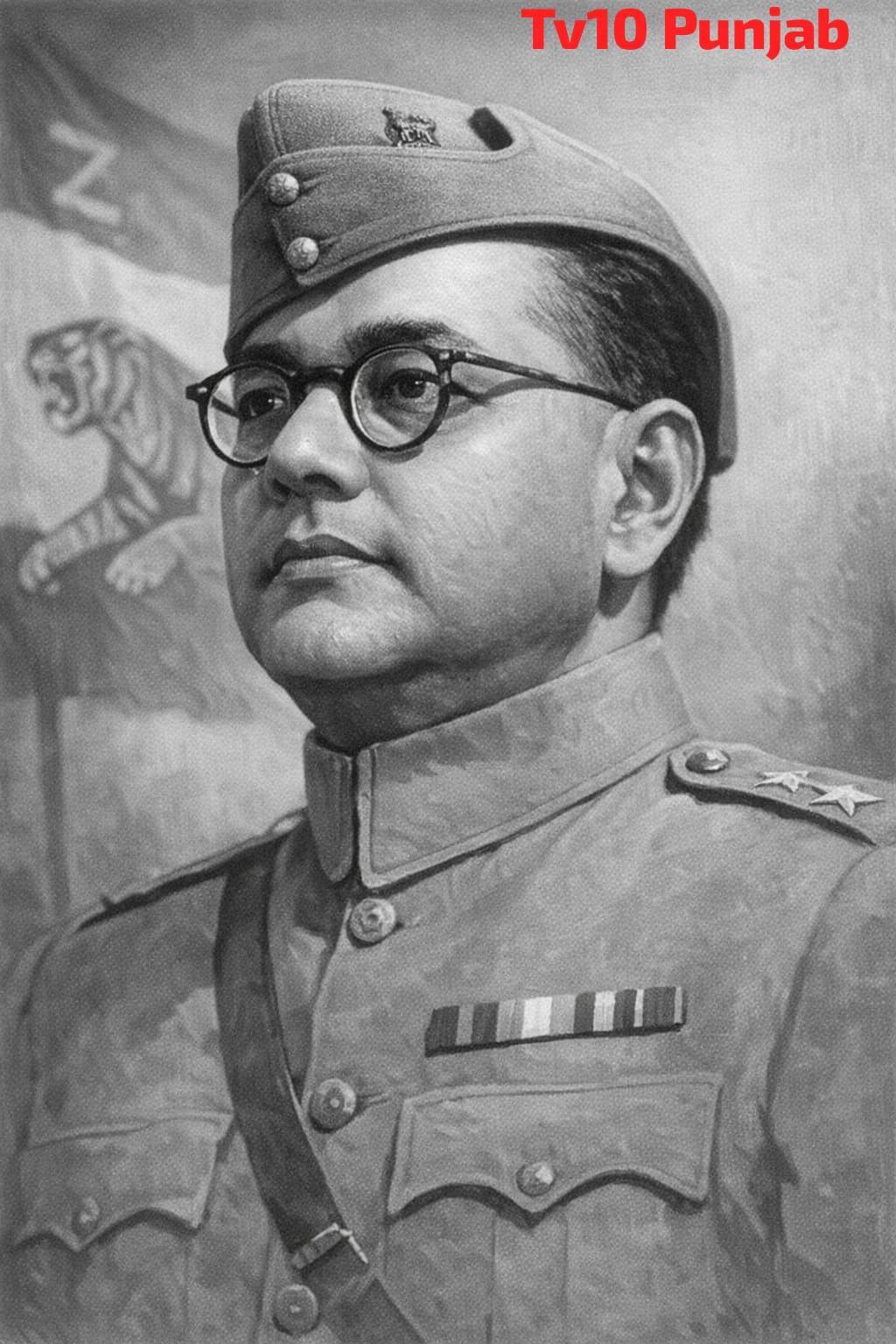
Bose was a man of action who believed that “freedom is not given, it is taken.” His life was a whirlwind of brilliance, rebellion, and international intrigue. From a top-tier civil servant to the supreme commander of the Indian National Army (INA), Netaji’s journey is one of the most cinematic and impactful chapters in modern history.
The Making of a Revolutionary
Subhash Chandra Bose was born on January 23, 1897, in Cuttack, Odisha. He was the ninth child in a large, well-to-do family. His father, Janakinath Bose, was a prominent lawyer, and his mother, Prabhavati Devi, was a woman of strong character.
From a young age, Subhash was a brilliant student. He was deeply influenced by the teachings of Swami Vivekananda and Ramakrishna Paramahamsa, which instilled in him a sense of spiritual nationalism and a duty toward the downtrodden.
The ICS Sacrifice
To fulfill his father’s wishes, Subhash went to England to study for the Indian Civil Service (ICS) exam. At the time, the ICS was the most prestigious career for an Indian, but it required swearing allegiance to the British Crown. Despite having very little time to prepare, Subhash ranked fourth in the competitive exam.
However, his heart wasn’t in it. He couldn’t reconcile serving the colonial masters who were oppressing his countrymen. In 1921, he did something unthinkable: he resigned from the ICS. He wrote to his brother Sarat, “Only on the soil of sacrifice and suffering can we raise our national edifice.”
The Rising Star of the Congress
Returning to India, Bose joined the Indian National Congress under the mentorship of Chittaranjan Das. He quickly rose through the ranks due to his charisma and organizational skills.
In the late 1920s and 30s, Bose, along with Jawaharlal Nehru, represented the “young Turk” faction of the Congress. They were impatient with the slow pace of the “Dominion Status” negotiations and demanded Purna Swaraj (Complete Independence).
The Rift with Gandhi
By 1938, Bose was elected President of the Congress at the Haripura Session. However, ideological differences began to surface. While Gandhi believed in the power of Ahimsa (non-violence) and moral persuasion, Bose believed that Britain’s difficulty during the impending World War II was India’s opportunity.
In 1939, Bose sought re-election at the Tripuri Session. Gandhi supported a different candidate, Pattabhi Sitaramayya. To the shock of the establishment, Bose won. Gandhi took the defeat personally, famously stating, “The defeat is more mine than his.”
Realizing he could not function effectively without the support of the Congress working committee, Bose resigned and formed the All India Forward Bloc, a faction within the Congress aimed at unifying the left-wing elements.
The Great Escape
When World War II broke out, the British government placed Bose under house arrest in Calcutta (Kolkata). They feared his ability to mobilize the masses against the war effort. It was during this confinement that Bose planned one of the most daring escapes in history.
In January 1941, disguised as a Pathan named Ziauddin, Bose slipped past British guards. He traveled by car to Dhanbad, by train to Peshawar, and then trekked through the rugged terrain of Afghanistan into the Soviet Union, eventually reaching Berlin, Germany.
His goal was simple: to seek the help of Britain’s enemies to liberate India. While his meeting with Adolf Hitler remains a controversial historical footnote, Bose’s primary focus was the creation of the Free India Center and the Legion Freies Indien, made up of Indian prisoners of war.
The Indian National Army (INA) and “Chalo Delhi”
The tide of the war shifted when Japan entered the fray in Southeast Asia. Bose realized that the geographical proximity of Japan to India offered a better strategic advantage. In 1943, he made a perilous 90-day journey in a German U-boat and a Japanese submarine to reach Singapore.
There, he took command of the Indian National Army (Azad Hind Fauj), which had been initially formed by Rash Behari Bose and Captain Mohan Singh.
The Provisional Government
On October 21, 1943, Netaji announced the formation of the Provisional Government of Free India (Azad Hind). He was the Head of State, Prime Minister, and Minister for War. He gave the famous slogan:
“Give me blood, and I shall give you freedom!”
He also established the Rani of Jhansi Regiment, one of the first all-female combat units in modern history, led by Captain Lakshmi Sahgal. This proved Bose’s progressive vision for a future India where men and women fought side-by-side.
The Battle for the Motherland
In 1944, the INA, fighting alongside Japanese forces, crossed the Burmese border and stepped onto Indian soil. They hoisted the tricolor flag in Moirang, Manipur. For a brief moment, it seemed that Netaji’s dream of marching to Delhi was within reach.
However, the tide turned. The monsoon season made logistics impossible, the Japanese supply lines collapsed, and the Allied forces launched a massive counter-offensive. Despite their bravery, the INA was forced to retreat.
Even in defeat, the INA had done something remarkable: it had broken the myth of the British Empire’s invincibility and, more importantly, it had sparked a fire of rebellion within the British Indian Army.
The Mystery of His Death
On August 18, 1945, shortly after the Japanese surrender, it was reported that Subhash Chandra Bose died in a plane crash in Taihoku (Taipei), Taiwan.
However, many Indians refused to believe it. For decades, theories persisted that he had escaped to the Soviet Union, or that he lived out his days as a hermit (Gumnami Baba) in Uttar Pradesh. While multiple commissions (Shah Nawaz Committee, Khosla Commission, and Mukherjee Commission) have investigated the matter, the “official” version remains the plane crash, though a large section of the public remains skeptical to this day.
The Legacy: Why Netaji Matters
Although Netaji did not live to see the dawn of independence on August 15, 1947, his impact was perhaps the final blow to British rule.
The INA Trials: After the war, the British held public trials of INA officers at the Red Fort. This backfired spectacularly. It unified Indians of all religions and prompted the Royal Indian Navy Mutiny of 1946. The British realized they could no longer rely on Indian soldiers to keep India enslaved.
Secularism in Action: The INA was a melting pot of Hindus, Muslims, Sikhs, and Christians. In Netaji’s army, there were no communal divisions—only Indians.
National Pride: He gave India its national greeting, “Jai Hind.”
Netaji Subhash Chandra Bose remains a symbol of ultimate sacrifice. He walked away from a life of comfort, survived multiple imprisonments, and traveled across the world under false identities, all for the singular goal of seeing his motherland free.
He was a visionary who dreamt of a modern, industrialized, and egalitarian India. Today, as India stands as a global power, the echoes of “Chalo Delhi” remind us that our freedom was bought with the courage of those who dared to defy an empire.