Health Desk
Sandeep Dhand
Nutritionist And Health Educator
Introduction
Spinal Muscular Atrophy Type 1 (SMA Type 1) is a rare but serious genetic disorder that affects the muscles of the body. It mainly occurs in infants and is one of the most common causes of death in babies due to genetic diseases. SMA weakens the muscles that control movement, breathing, swallowing, and other vital functions.
In simple terms, SMA Type 1 is a disease in which the muscles of the body lose strength over time because the nerves that control them are damaged or missing. It is caused by a defect in a specific gene called SMN1 (Survival Motor Neuron 1). This gene is responsible for producing a protein that helps motor neurons work properly. When this protein is missing or reduced, motor neurons die, and muscles start shrinking or wasting away.
Understanding SMA Type 1

SMA is divided into several types based on the age at which symptoms appear and how severe they are. These types include SMA Type 1, Type 2, Type 3, and Type 4.
SMA Type 1 is the most severe and the earliest form of the disease. It is also known as Werdnig-Hoffmann disease. Symptoms usually start within the first 6 months of life. Babies born with SMA Type 1 are often weak and may struggle to move their arms, legs, or head properly. They also have trouble swallowing and breathing.
Causes of SMA Type 1
The main cause of SMA Type 1 is a mutation in the SMN1 gene. This gene is responsible for making the SMN (Survival Motor Neuron) protein, which is essential for the survival of motor neurons in the spinal cord and brainstem.
When there is a defect or deletion in this gene, the body cannot produce enough SMN protein. As a result, the motor neurons—nerve cells that control muscle movement—begin to die. Without these neurons, muscles become weak and begin to waste away, a process called muscle atrophy.
SMA is an inherited condition, meaning it is passed from parents to their children. For a child to develop SMA Type 1:
Both parents must carry a faulty SMN1 gene.
The child must inherit two defective copies of the SMN1 gene (one from each parent).
Parents who each carry one faulty copy of the gene are called carriers. Carriers do not usually have symptoms of SMA, but when two carriers have a child together, there is:
A 25% chance the child will have SMA.
A 50% chance the child will be a carrier.
A 25% chance the child will be unaffected.
How SMA Affects the Body
Motor neurons are special nerve cells that send signals from the brain and spinal cord to muscles to make them move. When these neurons stop working properly, the muscles cannot receive the right signals, leading to weakness and shrinkage.
In SMA Type 1, this process happens very early and very quickly. Babies with this condition often lose the ability to:
Hold their head up
Sit without support
Move arms and legs normally
Swallow or feed properly
Breathe without assistance
Because the muscles of the chest are also weak, these babies may have difficulty expanding their lungs fully. This can lead to breathing problems and frequent respiratory infections.
Symptoms of SMA Type 1
The symptoms of SMA Type 1 usually appear before 6 months of age. The most common signs include:
- Severe muscle weakness: The baby feels floppy, often called a “floppy baby.”
- Poor muscle tone: The arms and legs are soft and weak.
- Difficulty holding head up: Babies cannot lift their heads or roll over.
- Weak cry: The baby’s cry may sound soft or weak.
- Feeding problems: Difficulty sucking or swallowing milk.
- Breathing issues: Shallow breathing or fast breathing due to weak chest muscles.
- Little movement: The baby may not kick or move arms and legs much.
- Tongue twitching: Small tremors or twitching may be noticed on the tongue.
- Growth delay: Slow physical growth and delayed milestones.
- Lack of reflexes: Deep tendon reflexes like knee jerk may be absent.
As the disease progresses, muscle weakness worsens, and without medical support, breathing problems can become life-threatening.
Diagnosis of SMA Type 1
Diagnosing SMA Type 1 early is crucial for proper management and treatment. The diagnosis is based on clinical signs, family history, and genetic testing.
- Physical Examination
Doctors check for muscle weakness, reflexes, and movement ability. A “floppy” appearance in a baby is a major warning sign.
- Electromyography (EMG)
This test measures electrical activity in muscles and can detect abnormal nerve signals.
- Genetic Testing
The most accurate way to diagnose SMA is through a genetic test that looks for mutations in the SMN1 gene. This test confirms the diagnosis.
- Muscle Biopsy (Rarely Needed)
A small piece of muscle tissue is examined under a microscope to check for damage, though this test is less common today due to genetic testing accuracy.
- Prenatal Testing
If parents are known carriers, prenatal genetic testing can check whether the baby will be affected.
Treatment Options for SMA Type 1
While there is no permanent cure for SMA Type 1, several advanced treatments can help slow the disease’s progression, improve muscle function, and extend life expectancy. Early diagnosis and medical intervention play a key role in managing symptoms.
- Gene Therapy
Zolgensma (onasemnogene abeparvovec) is a one-time gene therapy that delivers a healthy copy of the SMN1 gene into the patient’s cells. It helps restore SMN protein production, protecting motor neurons and improving muscle function.
It is given through an intravenous (IV) infusion and is approved for children under 2 years old.
- SMN-Enhancing Drugs
These medicines increase the production of SMN protein using the backup gene called SMN2.
Spinraza (nusinersen): Given as an injection into the spinal canal, it helps the body make more SMN protein.
Evrysdi (risdiplam): An oral medicine that can be taken daily, especially useful for home treatment.
- Supportive Care
Supportive therapies are essential for improving quality of life. These include:
Respiratory care: Breathing machines, suctioning, or oxygen support.
Nutritional support: Special feeding tubes or diets to maintain nutrition.
Physical therapy: Gentle exercises to prevent stiffness and improve posture.
Occupational therapy: Helps maintain daily activities.
Speech therapy: Assists in swallowing and communication.
Nutrition and Diet for SMA Type 1
Nutrition plays a vital role in managing SMA Type 1. Although diet cannot cure the disease, it can help maintain strength, prevent complications, and support overall health.
- Importance of Nutrition in SMA
Children with SMA Type 1 often have difficulty swallowing and chewing, which can lead to malnutrition and weight loss. Proper nutrition helps:
Support muscle and bone health.
Strengthen the immune system.
Maintain energy levels.
Prevent constipation and other digestive issues.
- Feeding Problems in SMA Type 1
Weak tongue and throat muscles cause difficulty swallowing.
Food or milk may go into the lungs (aspiration), leading to choking or infection.
Some children may need a feeding tube (gastrostomy) to get proper nutrition safely.
- Nutritional Guidelines
A. Caloric Intake
Children with SMA may need slightly fewer calories because they move less, but enough to maintain energy and avoid fatigue. A nutritionist should adjust calories based on the child’s needs.
B. Protein
Moderate protein helps muscle repair and immune strength. Too much protein is not needed if physical activity is low.
Sources: lentils, milk, curd, paneer, tofu, eggs (if non-veg), pulses.
C. Fats
Healthy fats support brain development and provide energy.
Sources: olive oil, ghee (in moderation), avocado, nuts (if safe), and seeds.
D. Carbohydrates
Easily digestible carbohydrates help prevent fatigue.
Sources: oats, rice, khichdi, dalia, fruits, and vegetables.
E. Vitamins and Minerals
Vitamin D & Calcium: For bone strength.
Iron: Prevents anemia.
Vitamin C: Supports immunity.
Vitamin B12: Aids nerve health.
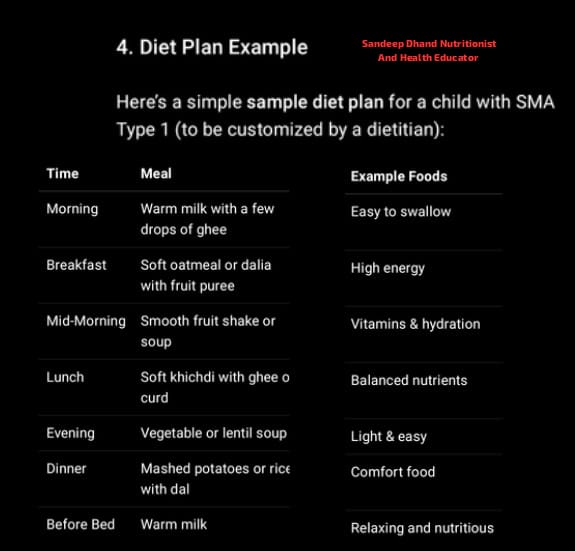
- Diet Plan Example
Here’s a simple sample diet plan for a child with SMA Type 1 (to be customized by a dietitian):
Time Meal Example Foods
- Feeding Tips
Offer small, frequent meals instead of large ones.
Keep the child upright while feeding to prevent choking.
Blend or mash food for easier swallowing.
Avoid hard, dry, or sticky foods.
Monitor for signs of fatigue or choking.
Living with SMA Type 1
Caring for a child with SMA Type 1 is emotionally and physically challenging. But with proper care, love, and support, many children live longer and more comfortable lives today than ever before.
- Emotional Support
Parents and families should seek counseling and support groups to share experiences and reduce stress.
- Physiotherapy
Helps maintain flexibility and prevent joint stiffness. Stretching, light movement, and posture exercises are useful.
- Respiratory Care
Use of chest physiotherapy, breathing exercises, and suction machines to keep the airways clear.
- Preventing Infections
Regular handwashing.
Vaccinations.
Avoiding crowded areas during flu season.
Recent Advances and Research
Medical research on SMA has made major progress in the last decade. The development of gene therapy and SMN-enhancing medicines has dramatically improved survival rates.
Scientists are also studying:
Stem cell therapy
Combination therapies
Nutritional supplements that may support motor neuron health.
These innovations bring new hope for children and families affected by SMA Type 1.
Prognosis and Life Expectancy
Without treatment, babies with SMA Type 1 often do not survive beyond 2 years due to respiratory failure.
However, with modern treatments like Zolgensma, Spinraza, or Evrysdi, and with proper nutrition and care, many children now live longer and healthier lives.
Conclusion
Spinal Muscular Atrophy Type 1 is a serious but manageable condition with the right combination of medical treatment, nutritional support, and emotional care. Early diagnosis, gene therapy, and a well-balanced diet can help improve the child’s quality of life.
Parents should never lose hope—scientific advances are bringing new opportunities and better outcomes every year. Love, patience, and proper medical care can make a world of difference in a child’s journey with SMA Type 1.