Introduction : For many years, the National Rural Employment Guarantee Scheme (NREGAS), later known as MGNREGAS, has served as an important source of employment for rural families across India. The scheme was designed to provide wage employment to people living in villages, especially those who struggle to find regular work. It has helped millions of households earn income during difficult times and has supported the development of rural infrastructure.
Now, discussions about a new proposal called VB-GRAM-G have attracted attention. The proposed system is expected to introduce several changes in the way rural employment programs are managed, funded, and monitored. Supporters believe these reforms could improve efficiency and transparency, while critics worry about their possible impact on employment opportunities and financial support for rural workers.

This article explains the proposed VB-GRAM model, how it differs from the existing NREGS framework, its possible advantages, challenges, and what it could mean for rural India.
What Is NREGAS?
The National Rural Employment Guarantee Scheme was introduced with the aim of providing employment opportunities to rural households. Under the scheme, eligible families can seek wage employment for a certain number of days each year.
The program was designed to achieve several goals:
Provide income support to rural families.
Reduce unemployment and underemployment.
Create durable rural assets.
Improve village infrastructure.
Strengthen rural economies.
Through the years, the scheme has funded projects such as:
Road construction
Water conservation
Pond development
Irrigation works
Land improvement
Plantation activities
Flood control projects
The scheme became one of the largest public employment programs in the world.
Why Is a Change Being Discussed?
Over the years, various concerns have been raised regarding the implementation of rural employment schemes. Some of the common issues include:
Delays in wage payments
Irregular monitoring of projects
Variations in performance among states
Questions regarding asset quality
Administrative inefficiencies
Funding challenges
To address these concerns, policymakers have discussed reforms that could make rural employment programs more efficient and accountable. The proposed VB-GRAM model is part of these discussions.
What Is VB-GRAM-G?
VB-GRAM-G is a proposed framework intended to replace or significantly reform the existing rural employment system.
The proposal seeks to create a more performance-based and outcome-focused approach to rural development and employment generation.
Instead of relying only on the current funding pattern, the new model may introduce additional criteria for allocating funds and measuring success.
The main objective is to ensure that public spending produces better results while continuing to support rural livelihoods.
Key Features of the Proposed VB-GRAM-G Model
According to the proposal, several major changes could be introduced.
- Performance-Based Funding
One of the most significant changes involves the way funds are distributed.
Under the proposed model, financial allocations may depend on measurable performance indicators rather than being based entirely on existing formulas.
States that perform better on certain indicators may receive higher allocations.
This approach aims to encourage better implementation and accountability.
- Greater Focus on Outcomes
Traditional employment schemes often focus heavily on the number of workdays generated.
The proposed model may place greater emphasis on:
Quality of assets created
Long-term community benefits
Economic impact
Sustainability of projects
This means success would not be measured only by employment numbers but also by the value created for rural communities.
- Improved Monitoring Systems
Monitoring and evaluation could become more important under VB-GRAM.
Possible measures include:
Digital tracking of projects
Better record keeping
Real-time reporting systems
Stronger audits
Increased transparency
The goal is to reduce errors and improve accountability.
- Increased Use of Technology
Technology is expected to play a major role in the proposed framework.
Digital tools could help in:
Worker registration
Attendance monitoring
Fund transfers
Project supervision
Data analysis
Greater use of technology may improve efficiency and reduce administrative delays.
- Focus on Asset Creation
The proposed reforms emphasize the creation of durable assets that can benefit villages for many years.
Examples may include:
Water harvesting structures
Irrigation systems
Rural roads
Community infrastructure
Environmental conservation projects
The intention is to ensure that public investment generates long-term economic benefits.
How VB-GRAM-G Could Differ From NREGS
Although both systems aim to support rural development, their approaches may differ.
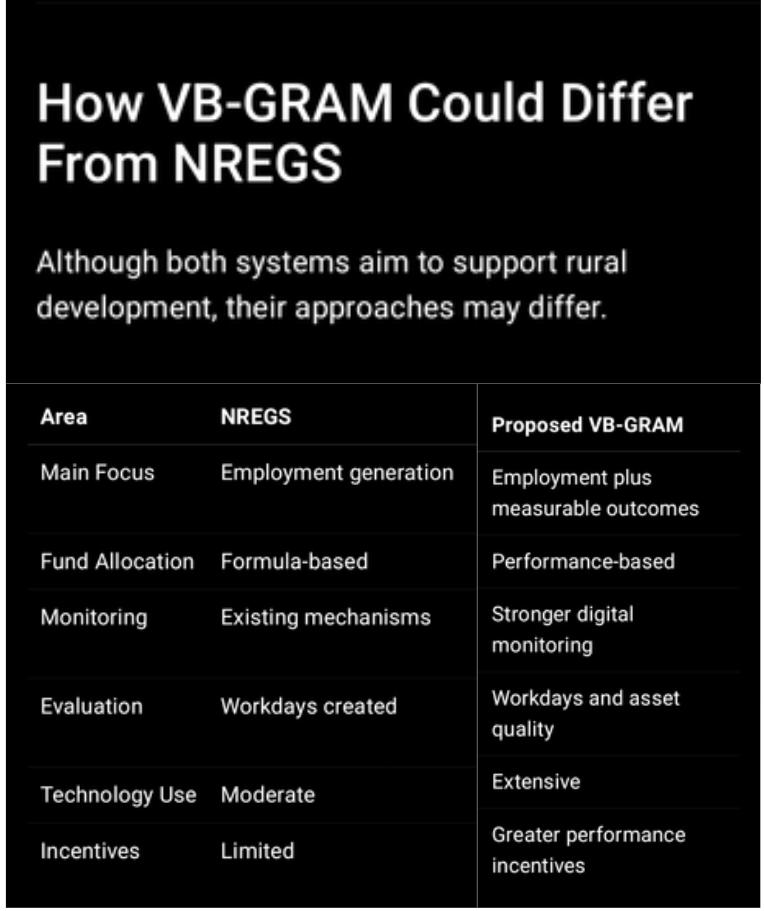
These differences suggest a shift from a purely employment-oriented approach toward a broader development-oriented model.
Possible Benefits of VB-GRAM-G
Supporters of the proposal believe it could bring several advantages.
Better Use of Public Funds
Performance-linked funding may encourage states and local authorities to use resources more effectively.
When funding depends on results, there may be greater motivation to improve implementation.
Higher Quality Projects
The focus on outcomes could encourage the creation of durable assets that provide long-term benefits.
Better-quality projects may improve:
Agricultural productivity
Water availability
Transportation
Environmental sustainability
Increased Transparency
Digital systems can make it easier to track spending and monitor projects.
Improved transparency may help reduce:
Administrative errors
Duplicate records
Delays in reporting
Faster Decision-Making
Real-time data collection could allow authorities to identify problems quickly and take corrective action.
This may improve overall program performance.
Stronger Rural Infrastructure
If more attention is given to asset quality, villages could benefit from better infrastructure that supports economic growth.
Improved infrastructure often leads to:
Better connectivity
Higher agricultural output
Increased employment opportunities
Concerns Raised About the Proposal
While supporters highlight the benefits, some experts and observers have raised concerns.
Risk of Reduced Employment Focus
One concern is that the scheme’s original purpose was to guarantee employment.
If performance indicators become the primary focus, employment generation could receive less attention.
This may affect households that rely heavily on wage employment.
Differences Between States
Not all states have the same resources, administrative capacity, or development levels.
States with stronger systems may perform better and receive more funds, while weaker states could struggle.
This may increase regional inequalities.
Challenges for Poorer Regions
Some rural areas face unique challenges such as:
Frequent droughts
Limited infrastructure
Difficult geography
Higher poverty levels
Performance-based funding may not fully account for these difficulties.
Technology Barriers
Although technology offers many advantages, challenges remain.
Some rural areas still face:
Internet connectivity issues
Digital literacy gaps
Technical infrastructure limitations
Successful implementation would require addressing these challenges.
Administrative Pressure
Local officials may face additional responsibilities related to monitoring, reporting, and performance measurement.
Without adequate support and training, implementation could become difficult.
Impact on Rural Workers
The most important question for many people is how these changes could affect workers.
If employment opportunities remain protected, workers may continue to benefit while also gaining from improved village infrastructure.
However, if the emphasis shifts too heavily toward performance indicators, some workers fear that employment availability could decrease.
The final impact would depend on how the proposed system is designed and implemented.
Key concerns for workers include:
Number of available workdays
Wage payment speed
Access to jobs
Registration procedures
Transparency in work allocation
Impact on Agriculture
Agriculture remains the backbone of rural India.
Programs that create useful rural assets can directly support farmers through:
Better irrigation
Improved water conservation
Soil improvement
Rural roads
Flood protection measures
If VB-GRAM successfully improves asset quality, agriculture could benefit significantly.
Better infrastructure often leads to increased farm productivity and higher incomes.
Impact on Village Development
Village development depends on more than employment alone.
Communities require:
Roads
Water resources
Sanitation facilities
Environmental protection
Public infrastructure
A stronger focus on long-term development could help villages become more self-sufficient and economically resilient.
Importance of Accountability
Public programs involve large amounts of taxpayer money.
Therefore, accountability is essential.
A well-designed monitoring system can help ensure that:
Funds reach intended beneficiaries.
Projects are completed properly.
Corruption risks are reduced.
Resources are used efficiently.
VB-GRAM-G places considerable emphasis on these aspects.
The Role of State Governments
State governments are likely to play a crucial role under the proposed framework.
Their responsibilities may include:
Planning projects
Monitoring implementation
Managing funds
Ensuring transparency
Meeting performance targets
States that adapt effectively may be better positioned to benefit from the new system.
The Future of Rural Employment Programs
Rural employment programs have evolved over time in response to changing economic and social needs.
Future reforms are likely to focus on balancing multiple objectives:
Employment generation
Rural development
Infrastructure creation
Transparency
Financial efficiency
Finding the right balance between these goals will be important for long-term success.
What Rural Communities Should Watch For
As discussions continue, rural communities may want to pay attention to several important questions:
Will employment guarantees remain protected?
How will funds be allocated?
What performance indicators will be used?
How will poorer regions be supported?
Will wage payments become faster?
How will technology be implemented?
What safeguards will exist for vulnerable workers?
The answers to these questions will shape the future impact of the proposed reforms.
Conclusion
The proposed VB-GRAM-G model represents a significant shift in thinking about rural employment and development. While the existing NREGAS framework has provided employment support to millions of rural households, policymakers are exploring ways to improve efficiency, accountability, and long-term development outcomes.
Supporters believe that performance-based funding, stronger monitoring, greater use of technology, and improved asset creation could make rural development programs more effective. At the same time, concerns remain regarding employment security, regional disparities, and implementation challenges.
The success of any new system will depend on its ability to balance employment generation with sustainable development. Rural workers need reliable job opportunities, while villages need durable infrastructure and economic growth. If these goals can be achieved together, the proposed reforms may contribute positively to the future of rural India.
Ultimately, the discussion around VB-GRAM-G highlights an important question: how can rural employment programs continue supporting workers while also creating stronger, more prosperous, and self-reliant villages for future generations?