Business Desk
Sandeep Dhand Ludhiana
Journalist And Research Analysist
The value of the Indian Rupee against the US Dollar has remained an important topic of discussion in India. Many people use the exchange rate as one way to understand how the country’s currency is performing over time. Since 2014, there has been considerable debate about the movement of the Rupee and how it compares with previous years.
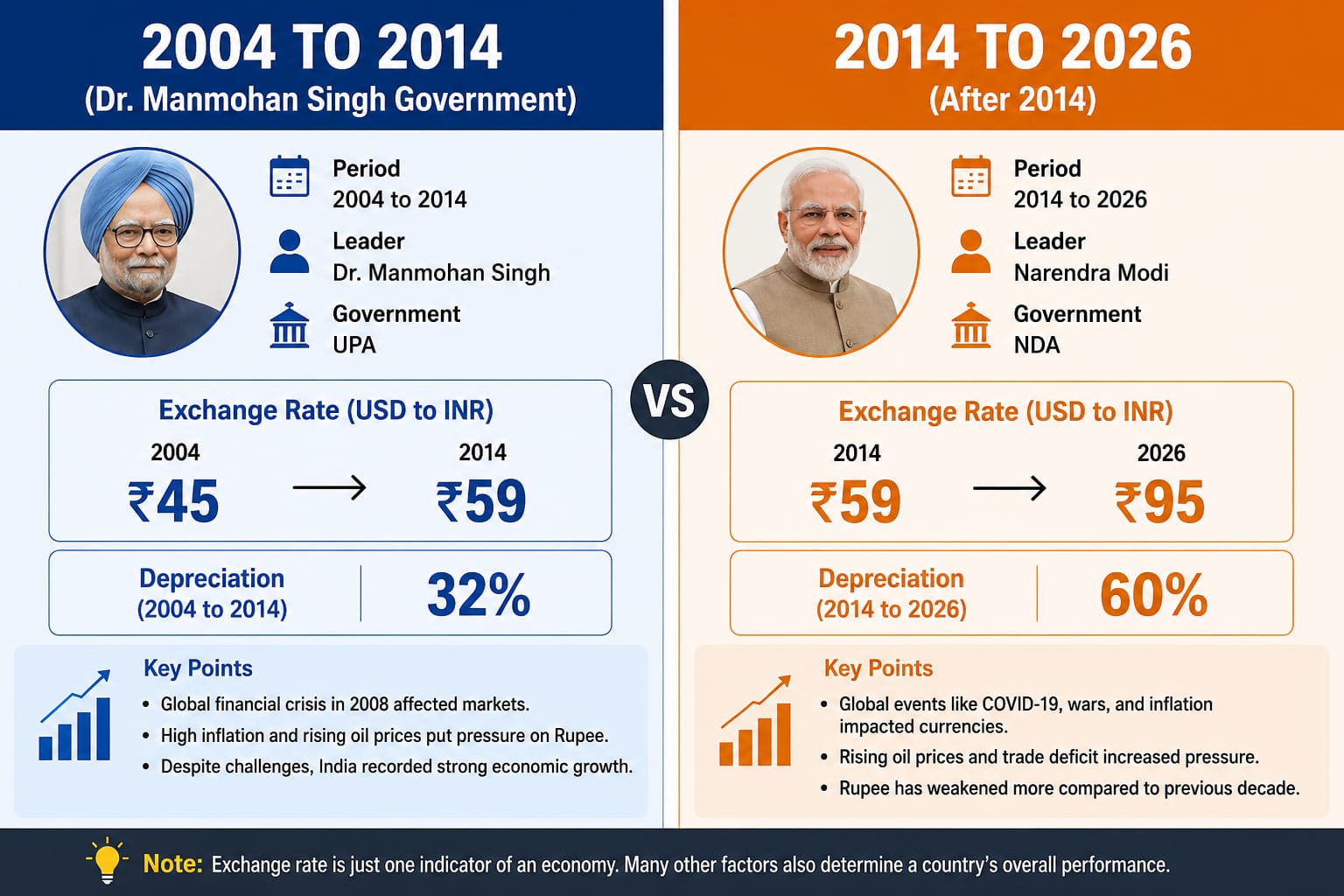
When Narendra Modi became Prime Minister in May 2014, one US Dollar was worth approximately ₹59. At that time, the Indian economy was recovering from several economic challenges, and many people expected the Rupee to become stronger in the coming years.
However, over the next decade, the Rupee continued to weaken against the Dollar. By 2026, one US Dollar was worth around ₹95. This means that the Rupee has depreciated by approximately 60 percent since 2014. In simple terms, Indians now need significantly more Rupees to buy one US Dollar than they did twelve years ago.
The depreciation did not happen overnight. Instead, it occurred gradually over several years due to a combination of domestic and international factors. One of the biggest reasons was the strong position of the US Dollar in global markets. Whenever the Dollar strengthens worldwide, many currencies, including the Indian Rupee, come under pressure.
Another major factor was India’s dependence on imported crude oil. India imports a large portion of its oil requirements from other countries. When international oil prices rise, more Dollars are needed to pay for these imports, increasing demand for the US currency and putting pressure on the Rupee.
The COVID-19 pandemic also played a significant role in global currency movements. The pandemic disrupted economies across the world, affected trade, and created uncertainty in financial markets. Like many other countries, India experienced economic challenges during this period, which influenced the movement of its currency.
Global conflicts, supply chain disruptions, inflation, and changing interest rates in major economies also contributed to fluctuations in the Rupee’s value. These are factors that affect currencies around the world and are not limited to India alone.
Many political discussions compare the Rupee’s performance after 2014 with its performance during the government of former Prime Minister Dr. Manmohan Singh. During his tenure from 2004 to 2014, the Rupee moved from around ₹45 per Dollar to about ₹59 per Dollar, representing a depreciation of roughly 32 percent over ten years.
In comparison, from 2014 to 2026, the Rupee moved from approximately ₹59 per Dollar to around ₹95 per Dollar, a depreciation of nearly 60 percent. Based on exchange-rate figures alone, the decline in the value of the Rupee has been larger during the period after 2014.
However, economists often point out that exchange rates should not be used as the only measure of a government’s performance. A country’s economic condition is also judged through GDP growth, employment, infrastructure development, exports, investment, and income levels. Currency values are influenced by both government policies and global economic conditions.
The figures nevertheless show a clear trend. Since 2014, the Indian Rupee has continued to weaken against the US Dollar, moving from around ₹59 to nearly ₹95 per Dollar. This represents one of the most significant long-term declines in the value of the Rupee in recent decades.
As India continues to grow as a major global economy, the performance of the Rupee will remain an important issue for businesses, investors, policymakers, and ordinary citizens alike. Understanding the reasons behind currency movements can help people view economic debates with greater clarity and a broader perspective.